


Why Act!’s Zoho CRM Comparison Is Misleading
I read the Act! article, Act! vs. Zoho CRM: Features, Pricing & Value for SMBs, and I can see several significant problems with its approach.
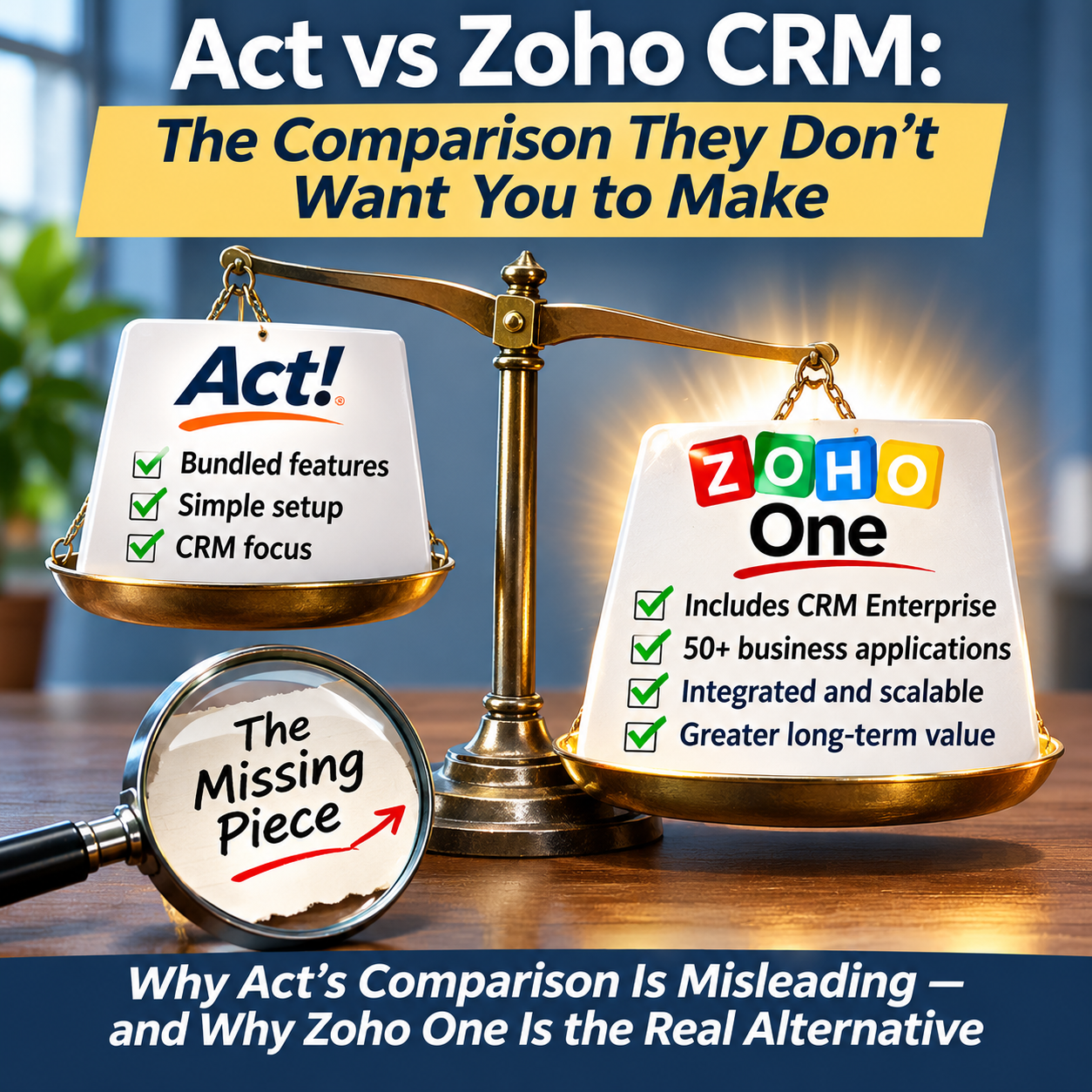
In fact, I think the biggest issue is that Act! is comparing its bundled product against one individual Zoho application while ignoring Zoho One entirely.
That’s not an apples-to-apples comparison. It’s not even particularly close.
For businesses evaluating a move from Act! to Zoho, this distinction matters enormously. Zoho One is designed to provide an integrated business software ecosystem, not simply a CRM with a collection of add-ons.
Let’s look at where the comparison falls apart.
1. The biggest omission: Zoho One
Act! compares its $30-per-user-per-month Advantage Standard plan against Zoho CRM Enterprise at approximately $40 per user per month.
But why are they comparing Zoho CRM Enterprise as though it represents the entire Zoho offering?
They should be comparing Act! against Zoho One.
Zoho One includes Zoho CRM Enterprise, along with a substantial collection of other Zoho applications covering:
-
Sales and customer relationship management
-
Email marketing and marketing automation
-
Email hosting and collaboration
-
Accounting and financial management
-
Project management
-
Customer support and help desk
-
Online meetings and video conferencing
-
Document management
-
Forms and surveys
-
Website live chat
-
Business intelligence and analytics
-
Human resources
-
Workflow automation
Rather than purchasing a CRM and then shopping for separate applications to handle other business functions, Zoho One brings these capabilities together in one ecosystem.
And importantly, Zoho One includes the Enterprise edition of Zoho CRM, not the lower-tier Standard edition.
That makes Act!’s decision to use Zoho CRM Enterprise as its comparison point particularly questionable. It leaves out the very product that businesses should be evaluating when considering the broader capabilities of Zoho.
2. The pricing comparison is designed to favor Act!
This is where the article becomes particularly problematic.
Act! presents the following comparison:
| Product | Advertised monthly price |
|---|---|
| Act! Advantage Standard | $30/user |
| Zoho CRM Enterprise | $40/user |
| Zoho One Standard – All Employee | $37/employee |
| Zoho One Standard – Flexible User | $67/user |
The Zoho One prices are based on annual billing and current published U.S. pricing. All-employee pricing requires licenses for every employee; flexible pricing allows you to license selected users.
Incredible Technology. Impossible Price.+1
Notice something?
Zoho One’s all-employee price is actually lower than the $40 Zoho CRM Enterprise price Act! uses in its comparison.
And for that $37, you’re getting more than CRM.
You’re getting an entire business software suite.
Act!’s comparison conveniently ignores this option while presenting Zoho as the more expensive alternative.
That’s a pretty important omission when the article is supposedly helping small businesses make an informed purchasing decision.
3. The add-on argument doesn’t hold up
Act! repeatedly emphasizes that Zoho requires additional subscriptions for email marketing, surveys, web chat, scheduling, and other business functions.
The problem?
Those are precisely the types of applications included in Zoho One Standard.
For example:
| Act! claims Zoho needs an additional subscription | Zoho One alternative |
|---|---|
| Email marketing | Zoho Campaigns |
| Surveys | Zoho Survey |
| Web chat | Zoho SalesIQ |
| Online scheduling | Zoho Bookings |
| Project management | Zoho Projects |
| Accounting | Zoho Books |
| Document management | Zoho WorkDrive |
| Business analytics | Zoho Analytics |
These applications are part of the Zoho One ecosystem.
Zoho One+1
There is an important distinction here: Zoho One includes applications with specific editions, usage limits and feature entitlements. Some advanced capabilities or additional capacity may require upgrades. But that is very different from suggesting that customers must purchase every one of these applications separately.
Act! is comparing its bundled offering against a standalone CRM subscription and then charging Zoho, on paper, for the additional applications that are already included in Zoho One.
That isn’t a fair comparison.
4. The implementation and account management argument is misleading
The article claims that Zoho onboarding can cost $2,000–$8,000 and that a dedicated account manager costs approximately 25% of the subscription fee annually.
It then adds those assumed expenses to its two-year cost calculation, arriving at $4,200 or more per user.
There are several problems with this calculation.
First, implementation is not the same as onboarding.
Zoho is a highly configurable CRM. A business with complicated sales processes, custom modules, integrations, automation, and data migration may absolutely need professional implementation assistance.
But that’s not a mandatory $2,000–$8,000 charge imposed on every Zoho customer.
Businesses can configure Zoho themselves, purchase assistance from Zoho, or work with an authorized Zoho partner.
Second, an account manager is not a requirement for using Zoho.
Many small businesses don’t need a dedicated account manager. They need a properly configured system, good training, and access to knowledgeable support when they need it.
Third, the calculation assumes expenses without establishing that they apply.
Act! adds a hypothetical onboarding fee and account management fee to Zoho’s subscription cost, then compares that inflated number against its own subscription price.
That’s not a meaningful total-cost-of-ownership analysis.
If we’re going to compare implementation costs, we should compare actual implementation requirements for both products, not assume one product requires thousands of dollars in services while treating the other’s onboarding as free.
5. A checklist of features doesn’t tell you how good the software is
Another issue with the article is that it treats features as though checking a box means two products offer equivalent functionality.
For example, both products may offer:
-
Contact management
-
Sales pipelines
-
Email marketing
-
Workflow automation
-
Reporting
-
Mobile applications
But that doesn’t mean they offer the same depth, flexibility, or customization.
Zoho CRM Enterprise offers extensive capabilities for businesses that need to build sophisticated sales processes, including:
-
Custom modules and relationships between modules
-
Advanced workflow automation
-
Custom functions
-
Blueprint process management
-
Territory management
-
Advanced reporting
-
Multiple sales pipelines
-
Role-based security and permissions
-
APIs and integration capabilities
-
AI-powered assistance through Zia
Zoho One also provides a platform for connecting CRM with other business applications.
For example, a company can connect its sales process to accounting, project management, customer support, and marketing without having to piece together an assortment of unrelated products.
The real question isn’t whether both products have email marketing or scheduling.
It’s whether they can support the way your business actually operates as it grows.
6. The comparison ignores the value of an integrated business ecosystem
This is perhaps the most important distinction for a growing business.
Act! emphasizes its advantage of having one vendor, one bill, and one place to manage customer relationships.
Fair enough. Those are legitimate benefits.
But Zoho One offers that same general advantage on a much broader scale.
Consider a typical business workflow:
-
A prospect completes a website form.
-
The prospect enters Zoho CRM automatically.
-
Sales follows up and converts the prospect into a customer.
-
Zoho Books handles estimates, invoices, and payments.
-
Zoho Projects manages the customer’s project.
-
Zoho Desk handles support requests.
-
Zoho Analytics reports on the entire customer lifecycle.
The applications can share information and automate processes across departments.
This is not simply a CRM with some extra features thrown in. It’s an integrated business operating environment.
And businesses don’t have to implement all 50-plus applications on day one. They can start with the applications they need and expand as their requirements change.
The Operating System for Business+1
7. Act! is overlooking the long-term implications of choosing a CRM
A CRM decision shouldn’t be based exclusively on what a company needs today.
It should also consider what happens when the business grows.
Will you need:
-
More sophisticated automation?
-
Multiple departments accessing shared information?
-
Accounting integration?
-
Project management?
-
Customer portals?
-
Advanced reporting?
-
Marketing automation?
-
Custom applications?
-
Connections to other business systems?
These are important considerations.
Zoho’s ecosystem provides a path to expand without having to replace your CRM every time your business needs something new.
That’s one of the reasons I recommend looking at Zoho One rather than evaluating Zoho CRM in isolation.
8. What about Act!’s claim that it offers better value?
I don’t want to suggest that Act! has no value. It has served many small businesses well, and its bundled features, onboarding, and customer support are legitimate selling points.
But value isn’t determined by the number of features included in a subscription.
It’s determined by what those features can actually accomplish, how well they work together, how much flexibility they provide, and whether the software can grow with the business.
Act! lists its Standard plan at $30 per user per month, but that plan includes limitations on email sends, storage, and other functionality. Its Professional and Ultimate plans cost more.
Act!
Zoho One Standard, meanwhile, provides access to more than 50 business applications, including enterprise-level CRM capabilities.
Comparing the lowest Act! subscription with a standalone Zoho CRM subscription while ignoring Zoho One creates a very different impression of the marketplace than comparing the actual products businesses should be considering.
9. What I think businesses should actually compare
Here’s the comparison I would like prospective CRM buyers to make:
| Consideration | Act! Advantage | Zoho One Standard |
|---|---|---|
| CRM | Included | Zoho CRM with Enterprise-level capabilities |
| Email marketing | Included, plan-dependent limits | Zoho Campaigns |
| Accounting | Integration | Zoho Books |
| Project management | Higher-tier plan | Zoho Projects |
| Customer support | CRM support | Zoho Desk |
| Web chat | Included | Zoho SalesIQ |
| Surveys | Included | Zoho Survey |
| Business intelligence | Reporting and dashboards | Zoho Analytics |
| Custom applications | More limited options | Zoho Creator |
| Business applications | Primarily CRM and engagement | 50+ applications |
| Expansion | Upgrade Act! plans | Expand across Zoho applications |
Act!+2
The point isn’t that every business needs every Zoho application. The point is that Zoho One gives businesses the flexibility to use them when they do.
My bottom line
I’ve spent more than 20 years working with Act! and have converted nearly 400 Act! databases to other CRM platforms, including Zoho.
I know Act! well. I also know Zoho well.
I’m not suggesting that everyone should abandon Act! or that Zoho is automatically the right solution for every business.
But I do believe customers deserve accurate information when evaluating their software options.
The Act! article presents Zoho as an expensive CRM that requires purchasing numerous additional subscriptions to compete with Act!’s bundled offering.
It leaves out Zoho One, which fundamentally changes the comparison.
It uses hypothetical implementation and account management expenses to inflate Zoho’s estimated cost.
And it focuses on checking off individual features rather than examining the depth, flexibility, and integration capabilities of the products.
If you’re evaluating Zoho, don’t stop at Zoho CRM. Look at Zoho One.
For $37 per employee per month with annual all-employee licensing, you’re looking at an extensive business software ecosystem, including Zoho CRM with Enterprise-level capabilities.
Zoho One: Incredible Technology. Impossible to beat Price.
That’s a very different proposition than the one Act! wants you to believe you’re comparing.
And if you’re an Act! user considering a move, make sure you’re comparing the right products before making your decision.
Disclosure: Tech Benders is an Advanced Zoho Partner and provides Zoho CRM implementations, training, consulting, and Act! to Zoho migrations.
Leave a Reply